October 6, 2026
.webp)
Young workers are choosing hands-on careers, and the employers who can find and confirm their skills first will fill seats sooner.
A generation that watched tuition climb and entry-level office work wobble is picking up tools, and the employers who can reach them first stand to benefit most. Recent NBC News and CBS News coverage follows young electricians, HVAC technicians, welders and asphalt crews who chose the trades for stability, hands-on work and a career path that does not begin with major debt.
Many of them also record their workdays and post them online. NBC News reported that two out of three Gen Zers say social media has increased their interest in the trades, a stronger influence than teachers, siblings or extended family. That habit of showing the work is exactly what hiring in the trades has been missing.
The shift is good news for an industry with more work than workers. It also raises a practical question for anyone who hires in the trades or backs the companies that help them hire: when this many capable people arrive at once, how does an employer find the right ones, verify what they can do, and bring them on quickly?
%20(1).webp)
The interest is showing up in enrollment, apprenticeships and hiring data, not only on social media. These are the figures reported by NBC News and CBS News.
• Vocational degrees: the share of 17 to 21 year olds with two-year vocational degrees reached its highest level in more than three decades last year, double the rate in 2000 (NBC News).
• Open manufacturing jobs: the Bureau of Labor Statistics counts roughly 500,000 open manufacturing positions, and some estimates reach more than 2 million by 2033 (NBC News).
• Apprenticeships: the IBEW says itsprogram has grown 44% in four years, and one New Jersey local reports class sizes nearly doubled this year (NBC News).
• Career switching: a resume-building platform found that almost four in ten Gen Z college graduates are pursuing or working in blue-collar fields, and ADP’s top economist says healthcare and blue-collar hiring are outpacing office jobs (NBC News).
• Capital and policy: Black Rock and Google launched multimillion-dollar initiatives to train the next generation of construction workers, and federal aid for vocational programs expanded this year (NBC News).
The demand side is just as clear. NBC News reported that tech companies are lookingto trades workers to build AI data centers, with positions across construction sites, electrical grids and plumbing systems projected to go unfilled by the end of the decade, and the CEO of Nvidia has said workers building AI factories could see six-figure salaries.
Hiring in the trades still runs on 1955 logic in a 2026 labor market. Workers show up with real skills and a resume built for an office job they have never had, employers have no reliable way to confirm who can do the work before they hire, and trade schools lose track of graduates the day they leave.
A 19 year old who has spent a year on an asphalt crew and a first-year apprentice with a union card face the same problem. Each has something real to show, and neither has a fast way to show it. Employers face the mirror image, because every open seat costs money while the crew absorbs the extra work.
The stakes grow with the numbers. Projections put 1.4 million skilled trade jobs unfilled by 2030, and nearly four in ten electricians are already 45 or older. A wave of new workers only closes that gap if employers can find them, trust their records, and make an offer while the interest is still there.
.webp)
Employers who adapt to how Gen Z looks for work can fill seats with workers who are motivated, mobile and used to showing what they do. Four practices make the biggest difference.
• Meet candidates on their phones. Young tradespeople look for work between jobs and expect to see a listing, a pay range and a way to reply in a few taps.
• Hire on evidence. Photos and video offinished work, verified credentials and confirmed history tell you more than a resume format that was never built for the trades.
• Put pay up front. Workers filter out jobs below their floor, so a clear range gets more of the right applicants and fewer wasted calls.
• Build a line to trade schools and apprenticeship programs. Programs that verify their own graduates hand you candidates whose credentials are already confirmed.
These steps matter whether you have five open seats or five hundred, and they matter most for owners, foremen and office managers who hire on top of running the business.
.webp)
The trades are drawing training capital, public funding and a new generation of workers at the same time, and the missing piece is infrastructure that turns that interest into verified, hire able supply. Black Rock and Google are funding training, federal aid for vocational programs has expanded, and enrollment in two-year vocational programs is at a three-decade high.
Whoever owns the supply controls the market, and in the trades the valuable supply isthe verified kind: a trustworthy record of who is qualified to do what. A two-sided job board connects workers to employers and stops there. A platform that also brings in trade schools and government workforce agencies can verify skills at the source, produce outcome data funders have never had, and keeptracking careers after the hire.
That structure is hard to copy because it depends on institutional trust and partnerships built over years, not on a larger listing board or a newer app. It also compounds, since every verified worker makes the pipeline more useful to employers, and every placement gives schools and agencies more proof that their programs work.
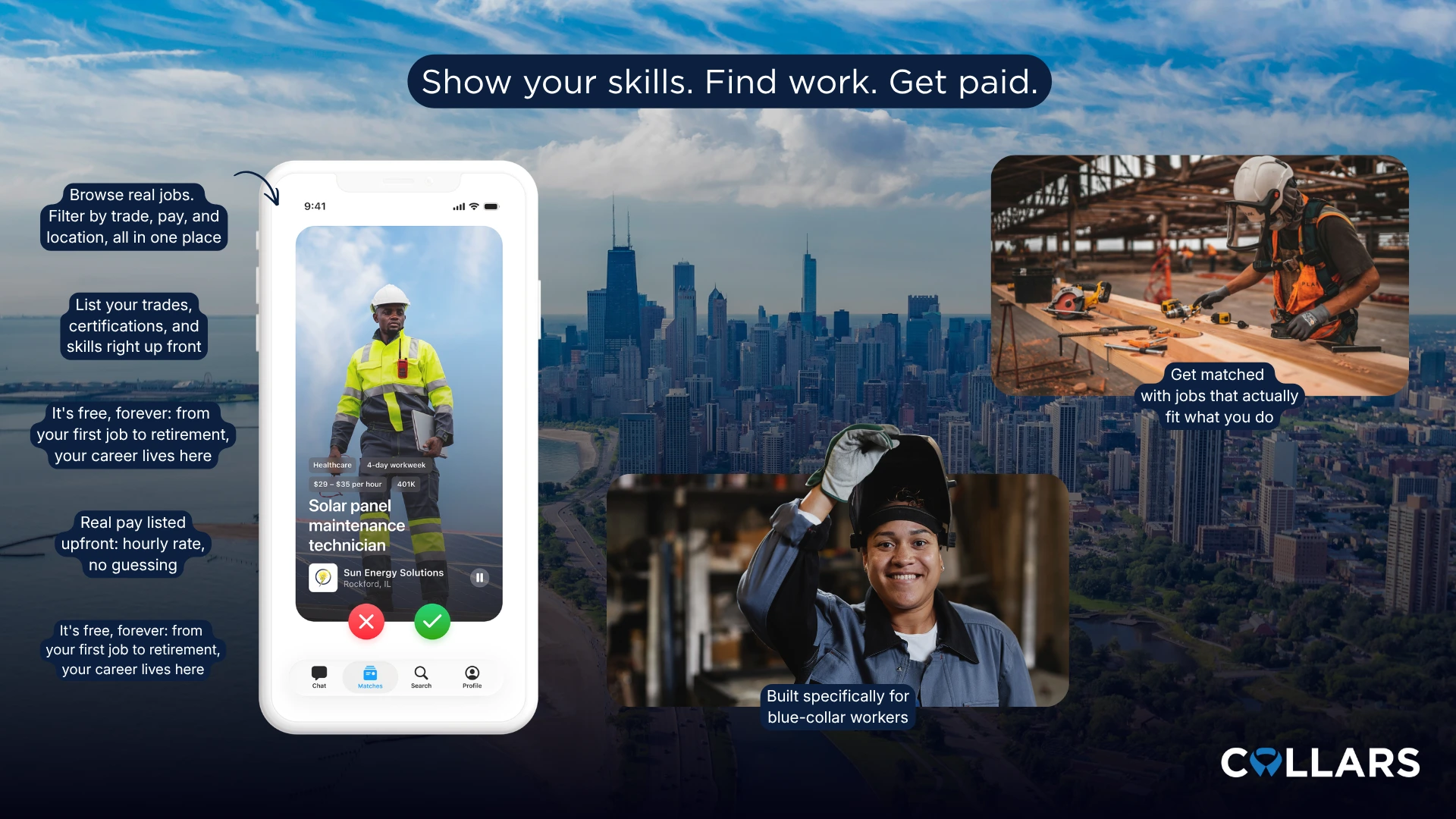
Collars is a mobile first hiring platform built for construction, transportation, agriculture and manufacturing, and it was designed around the problem this generation runs into: proving what you can do, quickly, to someone who needs to hire.
• For workers: a profile built from real photos and video of finished work instead of a resume, swipe based job discovery, a minimum pay filter, in-app messaging with employers, and CARM, an AI assistant that helps with registration.
• For employers: a hiring platform at employer.collars.io with a pipeline view of every applicant by stage, full profiles with credentials, languages, availability and verified work history, direct messaging and a straight forward offer workflow.
• For schools and government: Collars EDU tracks graduate outcomes for trade schools and apprenticeship programs, Collars Passport gives workers a portable verified record, Collars Data turns verified activity into better matches, and a read only portal gives workforce agencies outcome data they have not had before.
Collars connects workers, employers, trade schools and government around one verified record, which is how a wave of new workers becomes a pipeline employers can hire from with confidence.
The team behind it has worked the trades. Rocco Molfese is a fourth generation tradesman who built a construction company recognized on the Inc. 5000 list. Cheri Molfese built institutional partnerships, including with the YWCA, that showed her how many capable people get filtered out before they get a fair look. Daniel Garcia built the mobile first platform. As the founders put it, “We didn’t discover this industry, we lived it.”
GenZ is showing up ready to work. Collars is where trades hire.
Employers: start hiring at employer.collars.io.
Workers: build your profile at www.collars.io.
Resources
The figures in this article come from the following news segments.
Download our the Collars app now and start applying now.
Download

Collars is building a better future for the trades, by matching applicants and employers through a platform designed for real people, lasting careers, and the next generation of tradespeople.
.svg)